The Animals of the Panama Canal
Panama Canal animals one by one: monkeys, two- and three-toed sloths, crocodiles, caimans, toucans, iguanas and coatis, and where each one lives.
The animals of the Panama Canal live in two places: the forest of Soberania National Park on the east bank, and the shores and islands of Gatun Lake, the reservoir the ships cross. In the forest you look for two- and three-toed sloths, howler monkeys, coatis, agoutis, toucans and trogons; on the lake, white-faced capuchins, Geoffroy’s tamarins and howlers on the islands, American crocodiles, spectacled caimans, turtles and iguanas along the banks. The tour that covers both in one morning is Monkey Sightseeing Panama’s wildlife tour, from $60 a person (checked October 2026), plus a $20 park and lake fee on the day.
Where each animal lives
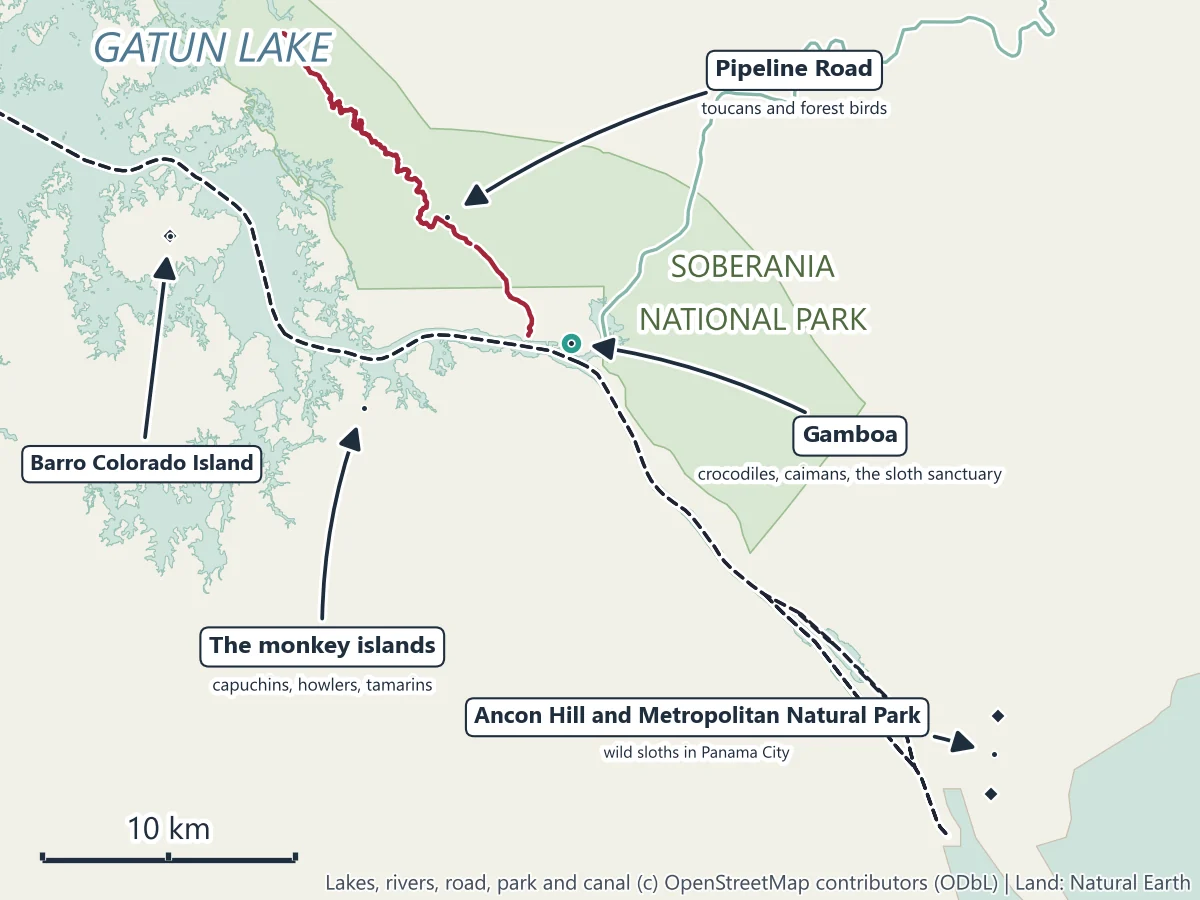
Panama’s environment ministry lists the animals a visitor can see in Soberania National Park: howler monkeys, coatis, sloths, anteaters, agoutis, owls, motmots, toucans, trogons, blue morpho butterflies, woodpeckers and iguanas. The Smithsonian counts 110 kinds of mammal, 335 of bird, 71 of reptile and 35 of amphibian on Barro Colorado Island alone, the research island in the middle of the lake.
Monkeys
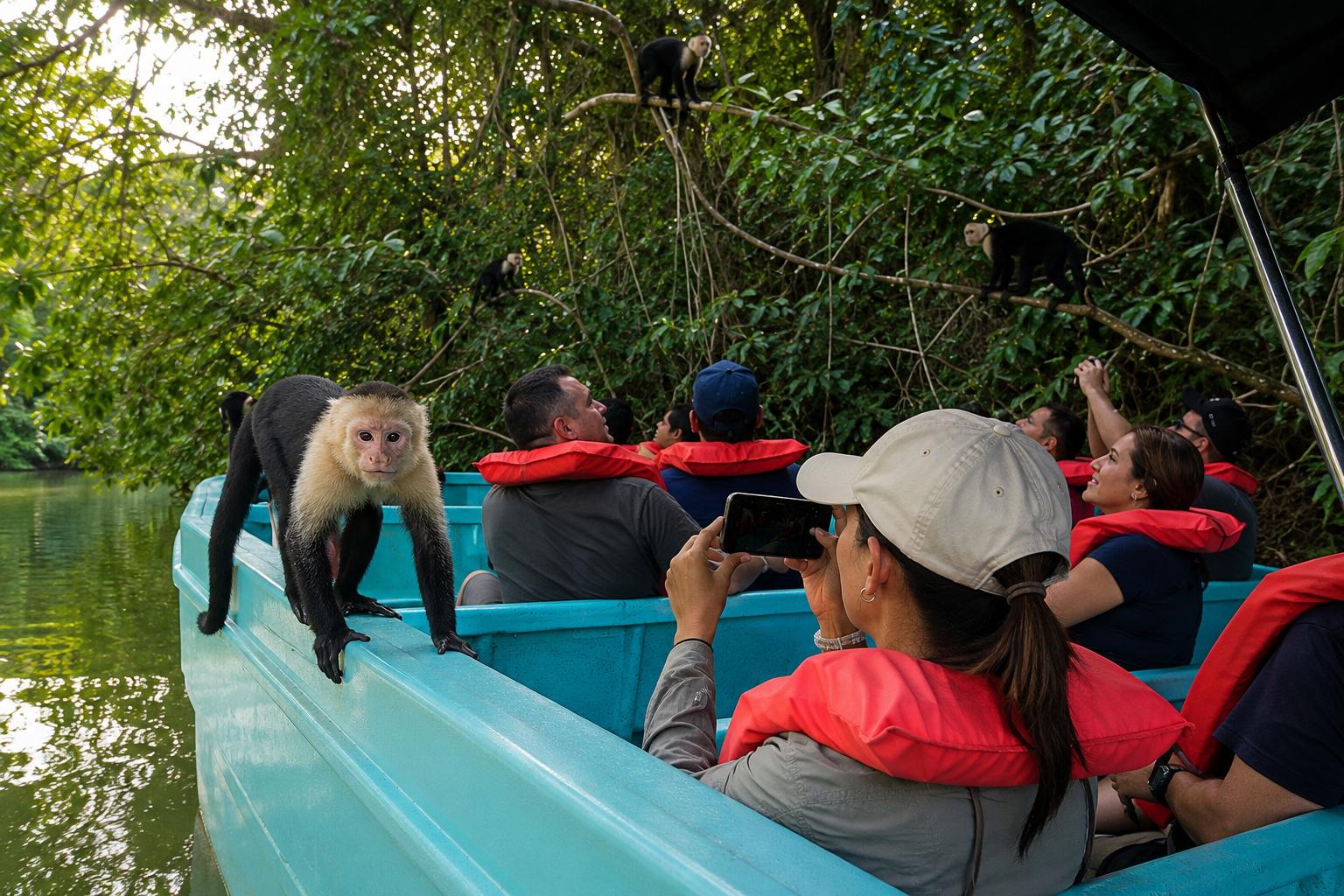
Three monkeys live on the small islands of Gatun Lake, and the boats go to them:
| Monkey | Scientific name | What to look for |
|---|---|---|
| White-faced capuchin | Cebus imitator | Black, with a cream face, throat and shoulders; bold and quick |
| Mantled howler | Alouatta palliata | Large and dark, with a golden fringe on its flanks; the males’ roar carries across the water |
| Geoffroy’s tamarin | Saguinus geoffroyi | Small, black and white, with a russet nape; called mono tití in Panama |
Howlers also live in Soberania’s forest, where you often hear them before you see them. A fourth canal monkey, the Panamanian night monkey (Aotus zonalis), is active at night and is not part of a daytime trip. monkeyislandtourpanama.com covers the monkey islands boat by boat, with each trip’s fee on the day.
Sloths
Panama has three sloths. The two you meet around the canal are Hoffmann’s two-toed sloth (Choloepus hoffmanni) and the brown-throated three-toed sloth (Bradypus variegatus); the third, the pygmy three-toed sloth, lives only on the island of Escudo de Veraguas, far from the canal. The Smithsonian’s researchers describe sloths sleeping about 15 hours a day, upside down, and taking up to a month to digest a meal. Algae grow in the grooves of their fur, which with their stillness makes them very hard to spot: look for a still, greyish-green ball high in the fork of a branch, and let the guide’s scope do the work.
On the wildlife tour, the safari truck looks for sloths before the boat. Ancon Hill and the Metropolitan Natural Park, both inside Panama City, have wild sloths too. The sloths guide covers all of the places, including the sanctuaries where you are sure to see one.
Crocodiles and caimans
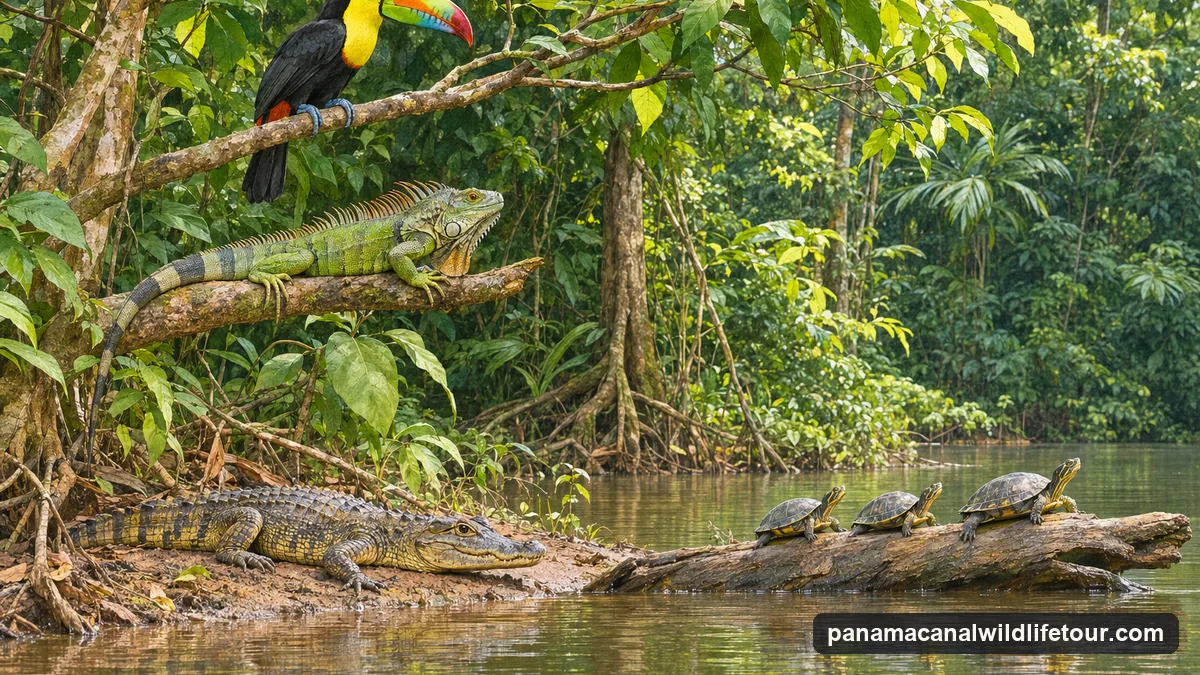
Two crocodilians live in the canal’s waters: the American crocodile (Crocodylus acutus), the big one, olive-brown with a narrow snout, and the smaller spectacled caiman (Caiman crocodilus), with a bony ridge between the eyes like the bridge of a pair of glasses. Panama lists the American crocodile as vulnerable and protects it by law. You see them basking on the banks of the lake and the Chagres River at Gamboa, or as a pair of eyes in the water. The crocodiles guide has more, including the rules.
Birds, toucans first
Panama’s environment ministry calls Pipeline Road, in Soberania, one of the most important birdwatching spots in the Americas, with more than 300 species to be seen there in 24 hours. The ones visitors want are the keel-billed toucan, with its rainbow bill, the yellow-throated (chestnut-mandibled) toucan and the smaller collared aracari; motmots, trogons and manakins come next. The Pipeline Road birding guide covers the road and the bird guides.
Iguanas, turtles, agoutis and coatis
Green iguanas lie along the branches over the water, and turtles line up on half-sunk logs. In the forest, the agouti, a large brown rodent the size of a rabbit, crosses trails and roads, and white-nosed coatis travel in noisy groups, tails up. Look down as well as up: leafcutter ants, frogs and blue morpho butterflies are as much a part of the walk as the animals in the trees.
On the boat and on the trail
- Do not feed anything. Panama’s rules for visitors to protected areas, in force since May 2026, ban feeding wild animals; keep your food in your bag and simply watch.
- Do not touch the monkeys or call them to the boat; keep your hands inside.
- Keep clear of crocodiles on any bank, and never swim in the lake.
- Bring binoculars if you have them, a hat, insect repellent and a rain layer.
Check dates for the wildlife tour
Who should pick something else
- Only the monkeys: a lake boat costs less; Almiza tour by My friend Mario's Gatun Lake boat is from $30 (checked October 2026), plus a boat fee on the day.
- Only the birds: see Pipeline Road birding.
- Rain-free days: see the best time guide.
More Trips with Open Dates
More Rainforest and Canal Trips with Open Dates
Wildlife boats, rainforest walks, birding and the canal locks, with live availability. Times and cancellation terms are on each listing.
See the Canal's Animals in One Morning
Monkey Sightseeing Panama's five-hour wildlife tour: sloths from a safari truck, the monkey islands by boat and a forest walk, with hotel pickup.
See dates